Our Church Structure
The Scottish Episcopal Church (SEC) is a self governing Church that has a presence in every part of Scotland. It makes it’s own laws, called Canon law, and set’s it’s own structure and policies.
- the College of Bishops, made up of all seven Bishops, provide spiritual and Episcopal leadership
- the Primus chairs the College of Bishops and speaks for the Church within Scotland and abroad
- the General Synod makes church-wide decisions on policy and Canon law, supported by the Boards and Committees
- the Dioceses organise local church life in a geographic area, and are led by a Bishop
- Clergy and Lay Leaders are responsible for the spiritual life of individual congregations
- Vestries are responsible for the administration of local congregations
The SEC chooses to be a member of a number of groupings of Churches across the world, referred to as Communions. The SEC is a member of the Anglican Communion, and the Porvoo Communion, and is in communion with other churches. Member Churches of the Anglican Communion are referred to as Provinces. The SEC refers to itself nationally as “the Province” because of this, with national bodies being described as “provincial”.
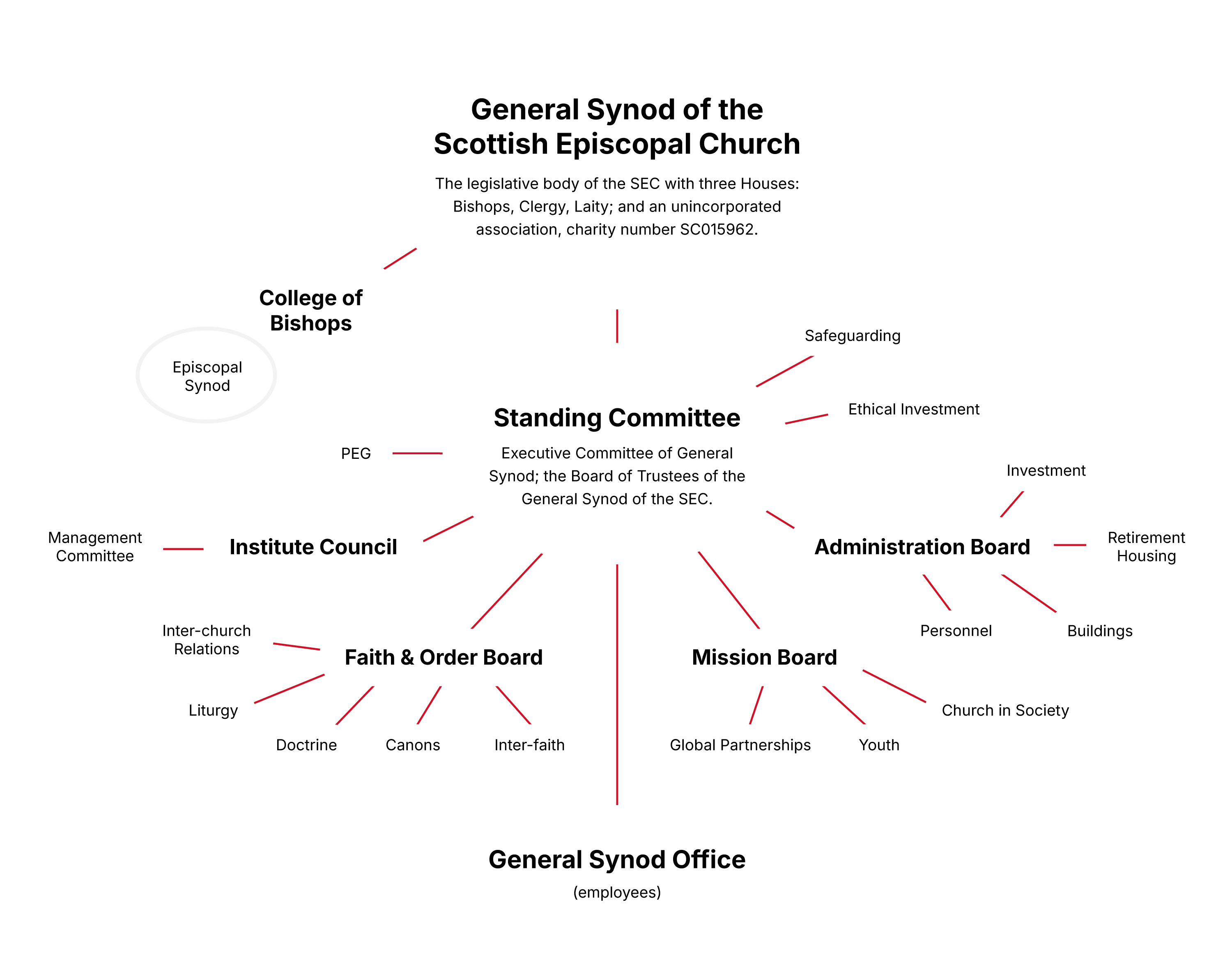
At a Provincial level, the Boards and Committees undertake much of the work of the SEC between meetings of the General Synod. They include the Standing Committee and four main Boards: Administration, Faith & Order, the Institute Council, and Mission. These boards put Synod policy into practice in their various areas of responsibility. The boards are supported by Committees, which are smaller working groups dealing with more specific subjects such as liturgy, canons, buildings, investment, safeguarding, youth work, mission, and church relations.
The seven Dioceses of the Church also hold their own Synods, as well as a series of boards and committees responsible for the work of each Diocese.
At a local level, each congregation is spiritually led by a member of the Clergy and by Lay Leaders. They also elect a Vestry to administrate their buildings, and to support the pastoral and spiritual life of the congregation in their area.
The below image demonstrates the provincial structure of the church. A PDF version of this can be downloaded here.