Standing Committee

The Standing Committee acts as the Executive Committee of the General Synod between meetings of the General Synod, implementing General Synod decisions and seeking to co-ordinate the work of the General Synod’s three boards.

Standing Committee

Standing Committee

The Standing Committee works with the College of Bishops in addressing strategic issues facing the Church as a whole, also responsible for the oversight of the General Synod Office.

Its members include the Conveners of the General Synod’s three boards (including the Primus), an independent Lay Convener, a further lay member and two clerical members appointed by General Synod and a representative of the College of Bishops.

  • Mrs C Johnston

    Convener

    Tenure: 2025 - 2030

  • Rt Rev the Bishop of Argyll and The Isles

    College of Bishops

  • Most Rev the Primus

    Convener,
    Faith & Order Board

  • Rev K Thomasson

    Convener,
    Mission Board

    Tenure: 2025 - 2030

  • Mrs J Whiteside

    Convener,
    Administration Board

    Tenure: 2024 - 2029

  • Rt Rev the Bishop of Brechin

    Convener,
    Institute Council

    Tenure: 2020 - 2025

  • Very Rev K Holdsworth

    General Synod Representative (Clergy)

    Tenure: 2023 - 2027

  • Rev D Hall

    General Synod Representative (Clergy)

    Tenure: 2024 - 2028

  • Dr A Martin

    General Synod Representative (laity)

    Tenure: 2023 - 2027

The Provincial Environment Group (PEG)

Turning ambition into action

General Synod affirmed in 2020 that the Scottish Episcopal Church should commit to working towards Net Zero carbon emissions by 2030. The Church in Society Technical Committee produced 10 points of guidance in 2021 to set the direction for practical action at Provincial, Diocesan, Church, and individual level. Thanks are due to the Committee for all the work they carried out, which has now been taken on by the Provincial Environment Group (PEG).


What is Net Zero?

This recorded webinar gives an overview of Net Zero and how the Scottish Episcopal Church intends to use this concept to take urgent, effective and measurable action to address the climate emergency. By watching this video you will gain an understanding of what Net Zero is, how it compares to Carbon Neutral as well as delve into the eight building blocks that are being used to create a robust, legitimate and transparent Net-Zero Action Plan.


In February 2023, a consultation for the Net Zero Action Plan (2023-2030) was launched, to give people the opportunity to help shape the future of our church’s environmental sustainability plans. This live stream event, hosted by the Rt Rev Ian Paton and consultant Robert Woodford, provided an overview of the proposed plan, including the values and principles that underpin it, its core objectives, and how you and your church can take action to address the climate emergency. You can watch a recording of the launch event here.

The first step in the Net Zero process was to produce a Toolkit and Checklist, embracing the 10 points of guidance. It included the Energy Footprint Analyser (EFA), enabling churches to calculate the carbon emissions associated with the energy usage in their buildings as well as create a baseline from which future emissions can be tracked.  PEG are asking that the data collected by churches is shared with the SEC in order to collectively monitor the progress being made to deliver on the goal of reaching net-zero by 2030. The original version of the Toolkit and Checklist can still be accessed here but churches are advised to use the new version (see next paragraph).

An updated version of the Net Zero Toolkit was released in 2023 to celebrate the start of the Season of Creation.

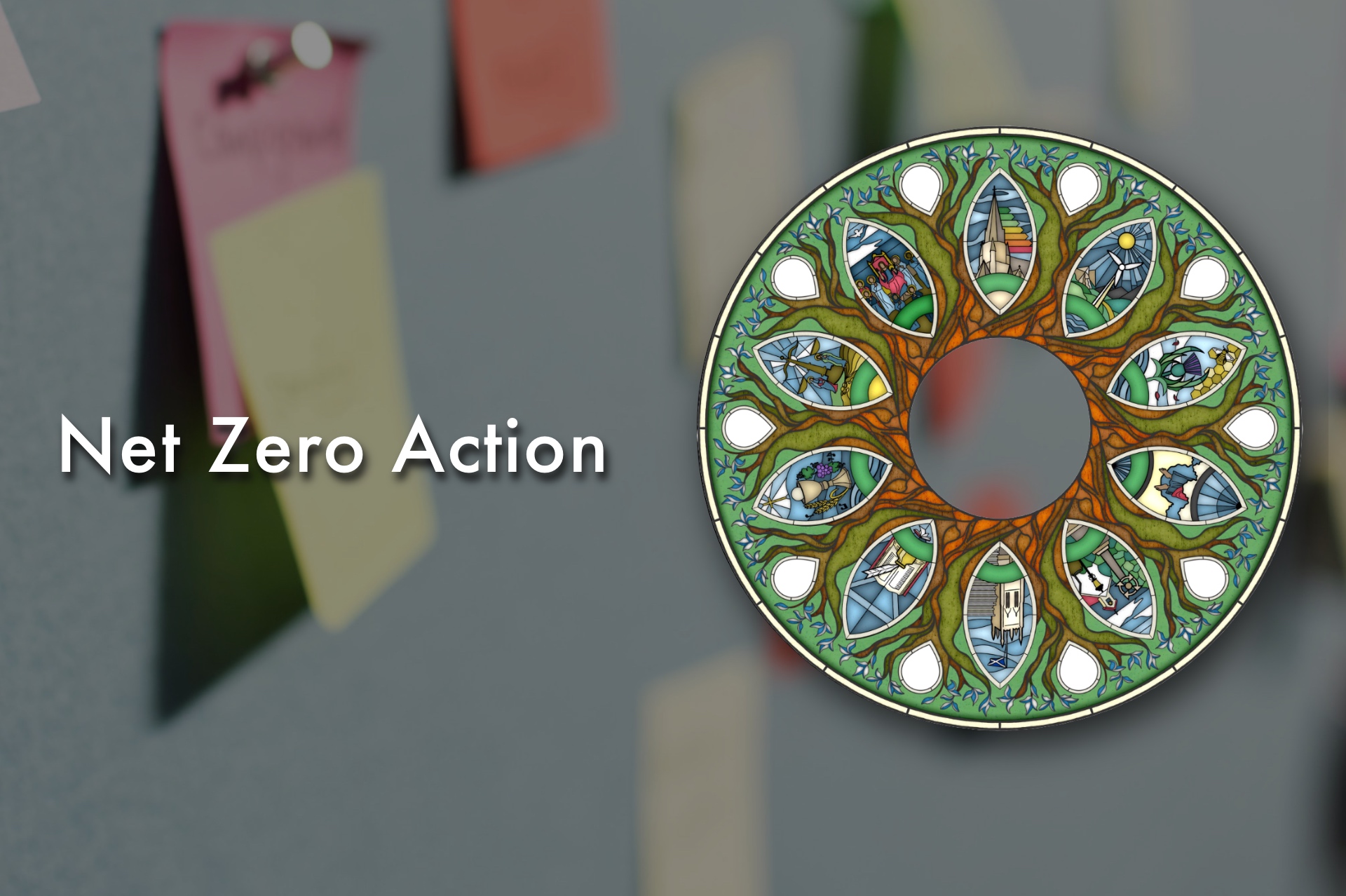
This online resource has been completely redesigned to complement the ten core objectives identified in the Scottish Episcopal Church’s Net Zero Action Plan (2023-2030), approved by General Synod in June 2023.

The new toolkit:

  • Provides an overview of Net Zero and how the Scottish Episcopal Church has defined it, as well as the values that have guided the approach.
  • Helps churches identify specific tasks they can take to work towards Net Zero 2030.
  • Demonstrates where help and support is available, including third-party tools and a list of grants to apply for.
  • Provides a simple guide to the process, recognising that one size does not fit all.
  • Integrates the online version of the new Net Zero Cards, also available now.

Integrating the online version of the Net Zero Cards directly into the toolkit enables a seamless link between the objectives identified in the Net Zero Action Plan (2023-2030), the many tasks outlined in the Net Zero Toolkit, and the individual actions described on the cards. Together, the new Net Zero Toolkit and online Net Zero Cards provide a one-stop resource, enabling all churches to take immediate steps to work towards Net Zero 2030. You can find out more and access the toolkit now at https://toolkit.secnetzero.org

All churches are encouraged to engage with the updated Net Zero Toolkit and the Net Zero Cards, and liaise with their contacts in their Diocesan Climate Change Groups.

Churches are also encouraged by the Provincial Environment Group to sign up for HeatHack workshops as part of the Scottish Episcopal Church journey towards Net Zero emissions by 2030.

The SEC is working in partnership with HeatHack, an organisation which arranges facilitated group sessions for community groups – such as churches – to help them understand what a net zero future holds for their own buildings.

A number of SEC churches have already signed up for workshops, and any churches unsure about what to do next to address Net Zero targets can get help by engaging with this helpful resource.

The workshops are based on the HeatHack programme funded by the Royal Academy of Engineering’s Ingenious programme and already running across the UK. HeatHack have adapted a programme specifically for the SEC, and workshops are available which will address two of the ten ‘petals’ of the SEC Net Zero plan – energy efficient improvements, and clean energy – to help with the practical use of energy on the premises.
For more information on HeatHack workshops, and how to sign up, click here.

Provincial Environment Group Membership

  • Rt Rev I Paton

    Convener

    Tenure: 2021 - 2026

  • Rev Dr V Cameron

    Tenure: 2021 - 2025

  • Mrs C Johnston

    Tenure: 2021 - 2025

  • Rev W Shaw

    Tenure: 2021 - 2025

  • Rev L S Smith

    Tenure: 2022 - 2026

  • Mr R Woodford

    Tenure: 2021 - 2025


Net Zero Action

The Scottish Episcopal Church’s (SEC) approach to the urgent action needed across the whole of the church, contained within Net Zero Action Plan 2023-2030, was affirmed at General Synod 2023.

Support for those who are working toward Net Zero can be found on our Net Zero Portal. Information found within the portal includes:

  • Resources – Guidance on buildings, resources for worship, webinars and case studies.
  • Stories – Blog posts of recent Net Zero action.
  • Funding – Details of external funding options, and internal SEC funding.
  • Workshops – Information on the HeatHack workshops available for churches.
  • Dioceses – Links to what’s happening in each Diocesan Environment Group.
  • Events – Calendar of events happening in local churches and communities.

Net Zero Team

Net Zero Delivery Director: Paul Williams (email)

Net Zero Empowerment Co-ordinator: Bethany Nelson (email) Bethany is the contact for St Andrews, Dunkeld & Dunblane.

Net Zero Innovation Co-ordinator: Jack Nevin (email) Jack is the contact for Aberdeen & Orkney and Brechin.

Carbon Projects and Data Officer: Neil Rawlins (email) Neil is the contact for Edinburgh.

Net Zero Sustainability Officer: Iain Johnstone (email) Iain is the contact for Argyll & The Isles and Glasgow & Galloway.

Net Zero Clean Energy Adviser: Daniel Prince (email) Daniel is the contact for Moray, Ross & Caithness.

The Net Zero team are keen to hear from anyone who has suggestions or stories. Contact – Net Zero Portal (netzerochurch.scot)


Net Zero Action Plan (2023-2030) – Consultation Overview Update as of June 2023

The consultation for the Scottish Episcopal Church’s net zero strategy ran from 15th February 2023 to March 28th 2023, a six week period in which stakeholders from across the province were given the opportunity to help shape the future of our church. Having reviewed 115 survey responses to the draft plan along with feedback gathered during the webinars, PEG have significantly revised the Net Zero Action Plan (2023-2030) in order to take into consideration the feedback from across the SEC community.

The updated version of the Net Zero Action Plan (2023-2030) was received well by Standing Committee when it was presented along with an estimate of anticipated implementation costs at the end of April. This plan was subsequently included in the papers for General Synod 2023. The Provincial Environment Group successfully sought approval of the Net Zero Action Plan (2023-2030) at General Synod 2023 (8 to 10 June).

You can download the updated Net Zero Action Plan here.

Please note, the consultation webpage is not an introductory document to Net Zero nor does it outline the first steps that your charge can take to tackle climate change – if you wish to start the journey in your church, please first download the Net Zero Toolkit.

If you missed the launch of the Net Zero Action Plan which took place on 15 February 2023 or want to view it again, you can watch it here.

To view a recording of the most recent consultation webinar, please click here.

Stakeholders across the Scottish Episcopal Church including charges and dioceses, as well as provincial boards and committees.

  • To engage in a participatory process with stakeholders across the Scottish Episcopal Church, enabling all parties to express their views and provide input into the proposed Net Zero Action Plan (2023-2030).
  • To obtain feedback on the overall Net Zero Action Plan, as it relates to the 2023-2030 period. As part of this, we wanted feedback on the Net Zero 2030 target definition including the proposed organisational boundary and the scopes of activities that are included in our target. We also wanted feedback on the specific ‘Key Results’ (now Desired Outcomes) that were associated with each of the ten core objectives.
  • We wanted to raise awareness of the net zero journey ahead, build momentum and align the community on the shared objectives and tasks ahead ready for motion approval at General Synod 2023.
  • We wanted to embrace the collective intelligence of the SEC community to collect a broad set of valuable feedback including additional ideas, opinions and insights and make adaptations based on this.
  • We welcomed any comment into the overall strategy, including the proposed resources and enabling interventions that are being recommended to support this ambitious goal.
  • The SEC community was given the opportunity to register for one of two online webinars on either Tuesday 21st February (16.30-18.00) or Thursday 9th March (11.30-13.00) – requesting that they bring any questions they had about the plan or strategy to these events. A total of 120 people attended these webinars with over 230 actions shared regarding changes already being carried out across the province.
  • People were asked to complete the formal online consultation survey, the results of which are available here.
  • PEG asked people to submit formal feedback on the draft Net Zero Action Plan (2023-2030) by 12 noon on Tuesday March 28th, when the online survey closed.
  • Data submitted as part of this process was then be reviewed and aggregated, with a presentation of the results and recommended changes presented for review by Provincial Environment Group on April 18th, 2023.
  • The final version of the PEG approved Net Zero Action Plan (2023-2030) was then offered to Standing Committee in April and subsequently included in the papers for General Synod 2023.
  • The Provincial Environment Group are seeking approval of the Net Zero Action Plan (2023-2030) via a motion at General Synod 2023 (June 8-10th).
  • Prior to the publishing of the proposed Net Zero Action Plan (2023-2030), representatives of the Provincial Environment Group had already had engagement regarding the high-level strategy with Bishops, Deans, the Provincial Buildings Committee, Church in Society Committee and Scottish Episcopal Institute, as well as guidance from Provincial Standing Committee.
  • PEG also had representation and presentations at each 2023 Diocesan Synod – this being a good platform from which to interact with members of the church about the consultation, as well as receive valuable informal feedback to guide the strategy.
  • Letters about the consultation were sent to all provincial committees and boards, as well as diocese administrators and secretaries.
  • Information about the consultation was included in the January 2023 edition of the SEC Inspires Online newsletter as well as highlighted in the February edition.
  • Information about the consultation was showcased on the front of the SEC website during the consultation with promotion also via SEC social media channels.
  • The consultation was launched on Wednesday 15 February via a live stream introduced by Bishop Ian Paton. You can review the launch video from the PEG area of the SEC website, under ‘Tackling climate change’. The launch event of the Net Zero Action Plan had 151 participants joining live, with a further 414 people viewing the event online afterwards. During the consultation, two webinars were run, which had a total attendance of 120 people.
  • All charges’ vestries were contacted directly via the GSO to ensure broad consultation, requesting at least one vestry member attend the launch or webinar.

Ethical Investment Advisory Group

The Ethical Investment Advisory Group reports to the Provincial Standing Committee and supports the work of the Investment Committee in managing the SEC’s Unit Trust Pool in an ethical manner that aligns with SEC’s Christian beliefs and investment objectives, by developing, reviewing and updating as appropriate the Investment Committee’s Ethical Investment Policy as well as considering current ethical concerns as they become relevant and assessing their potential impact on the Unit Trust Pool’s investments.

The Group offers advice to Standing Committee on issues such as public policy issues and ethical screening criteria, and has no investment powers.

It has no remit in respect of the SEC Pension Fund and cannot offer advice to individuals or any Vestry about their investments.

The Ethical Investment Advisory Group was appointed following discussions at General Synod 2019.

The relevant motion passed at General Synod 2019 stated that:

• The Ethical Investment Policy be updated to reflect the moral imperative to divest fully from fossil fuels and to extend the list of restricted categories for direct investments and pooled funds;
• Pending agreement of a revised Ethical Investment Policy, the current Ethical Investment Policy be retained; and
• There be formed an Ethical Investment Advisory Group to develop a strategy to enable the SEC to completely disinvest from unethical sources of revenue.”

In 2020 the last direct investment in a company involved in the extraction of fossil fuels was sold and agreements put in place with the Fund Managers to ensure that no further such direct investments are made.

The Policy Framework for Investment in Pooled Funds which was approved by General Synod in June 2021 is available here.

  • Rt Rev the Bishop of Brechin

    Convener

  • Mrs J Benvie

    Church in Society Committee

  • Dr D Bruce

    Ethics Consultant

  • Mr A Everett

    Investment Committee

  • Rev A Fairclough

    Investment Committee

  • Mr A Hunter

    Investment Committee

  • Dr E Poole OBE

    Ethics Consultant

  • Rev S Scott

    Church in Society Committee

Safeguarding Committee

The Provincial Committee for the Protection of Children and Vulnerable Adults is responsible for the General Synod policy in relation to work and ministry with children and vulnerable adults.

  • Mr R Baker

    Convener

    Tenure: 2020 - 2025

  • Rev Canon Dr M F Chatterley

    Member

    Tenure: 2021 - 2025

  • Ms A Jones

    Member

    Tenure: 2019 - 2027

  • Mr S Somerfield

    Member

    Tenure: 2021 - 2025

  • Rev M Goodman

    Member

    Tenure: 2022 - 2026

  • Rev R Campbell

    Member

    Tenure: 2022 - 2026